Tool use: internet search
Break the model out of the box — let it read the live web into the context window.
Search is the first and most useful tool. The mechanism is exactly the zip-file picture plus one move: the model issues queries, the web pages' text gets pasted into the context window, and now it can answer from that working memory. This is the fix for the knowledge cutoff — but not every app has it, and you often have to tell it to search.
His example is human: he watched White Lotus S3 episode one and wanted the release date for episode two. That's fresh — "not in the zip file, most likely." So the model must go fetch it.
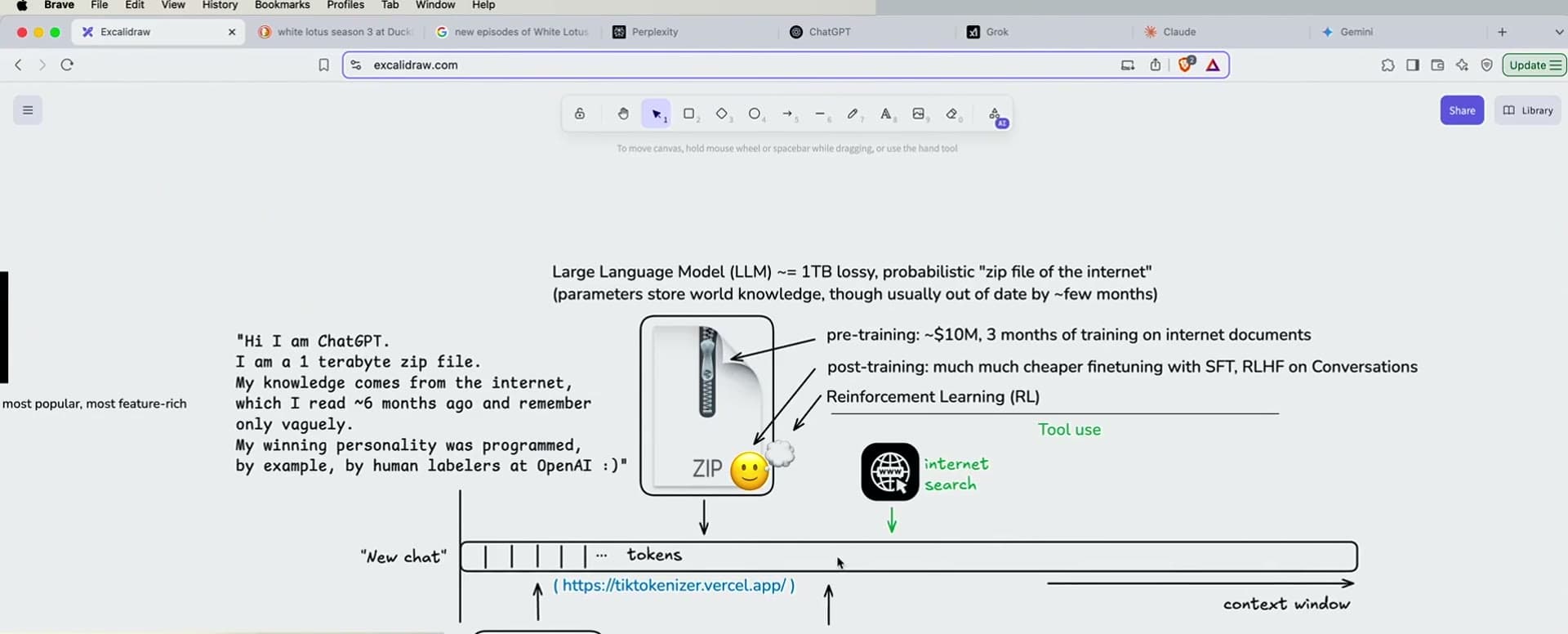
“Once we load the articles… think of their text as being copy-pasted into the context window — now they're in a working memory and the model can actually answer those questions.”
Andrej Karpathy·27:46
Search doesn't make hallucination impossible. The value is the links: "you can actually visit those web pages yourself and make sure that these are not hallucinations." Always keep the receipts.
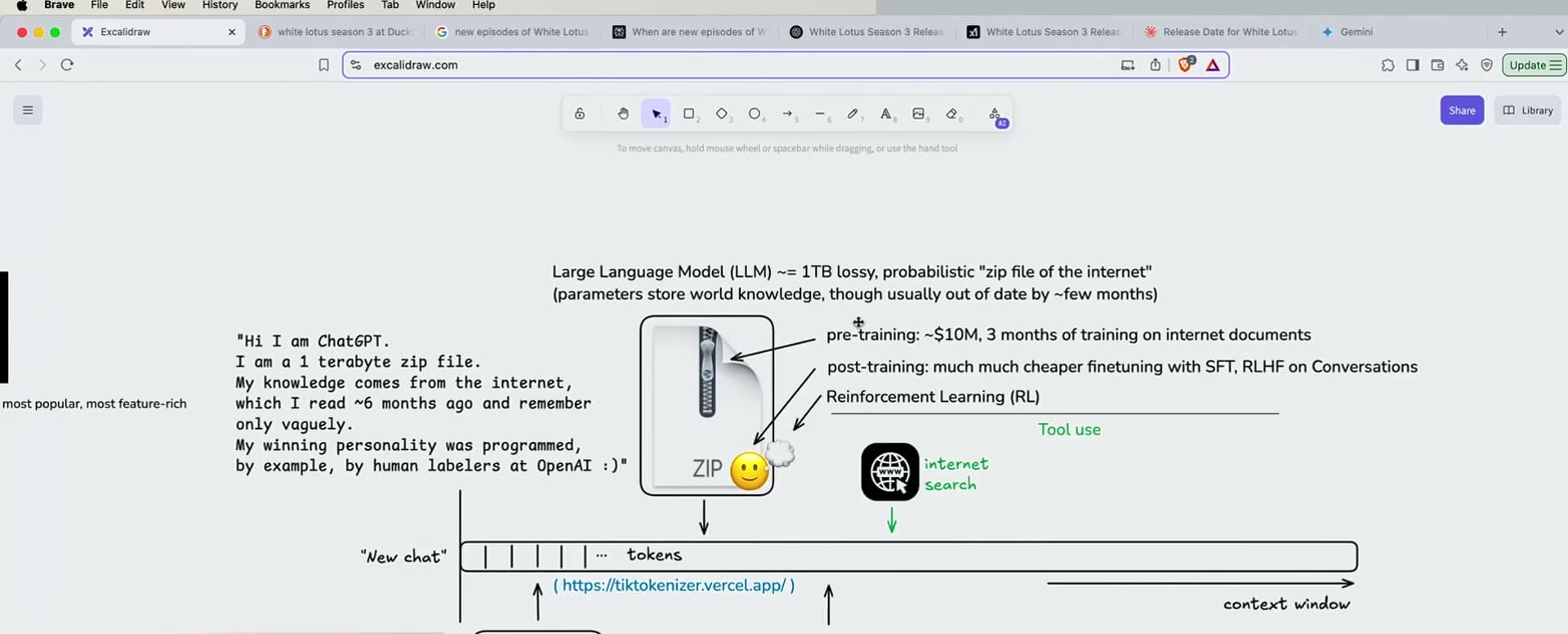
At filming: Perplexity (search-native), ChatGPT (a “Search” button), and Grok would search. Claude would not — it answered “as of my last update, April 2024.” Gemini 2.0 Pro lacked search while 2.0 Flash had it. Sometimes the model auto-detects it needs to search; when in doubt, tick the search box yourself.
The load-bearing points
- Search loads live web text into the context window, then answers from it.
- It's the direct cure for the knowledge cutoff.
- Use it for recent, niche, or changing facts — and read the citations.
- Availability is uneven; if unsure, explicitly turn search on.
Force the fetch
Ask something from this week both with and without the search toggle. See when the model searches on its own vs. guesses from stale memory.
Show the point
If it answers a fresh question with no “searching…”, it likely hallucinated a plausible date. Turn search on and compare.
Audit the sources
Run a factual search query, then actually open two of its citations and confirm the claim.
Show the point
This is the non-negotiable step. Search reduces hallucination; it doesn't eliminate it.
No — open the citations. Search grounds the model in real pages but the summary can still misread or fabricate. The links are what let you verify.