Read documents together (file uploads)
Drop a PDF or paste a chapter into context, and read it alongside the model.
Instead of relying on hazy parametric knowledge, you can hand the model the exact document. Upload a PDF (it's converted to text and loaded into the window) or paste a book chapter, then read it together — asking questions as you go. Karpathy says this dramatically increases retention and understanding, especially for hard, foreign, or very old texts.
He uploads a dense biology paper (Evo 2, a DNA foundation model) — outside his field — and just asks for a summary, then reads the abstract and intro with the model beside him.
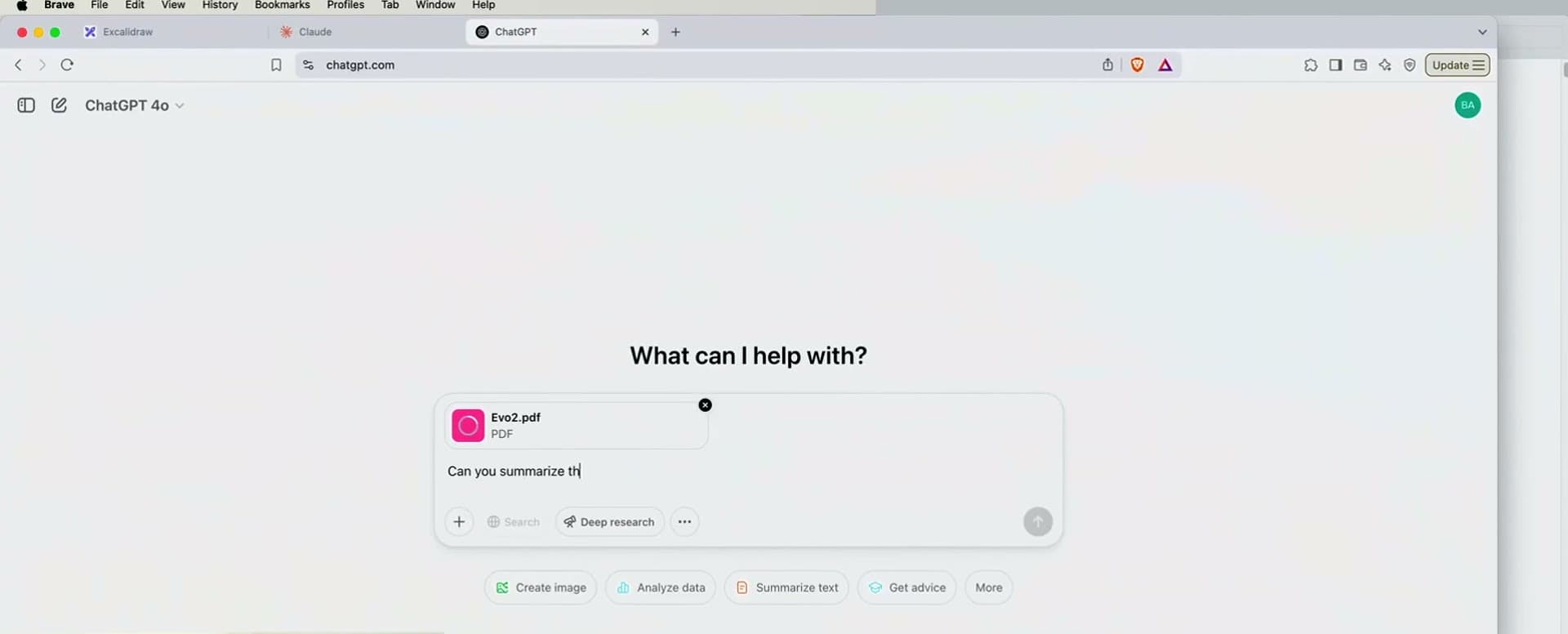
His favorite use is reading books. For The Wealth of Nations (1776, public domain via Project Gutenberg) he pastes the chapter he's on, asks for a summary to orient, then reads — pausing to ask whenever a passage is dense or the 18th-century language is opaque.
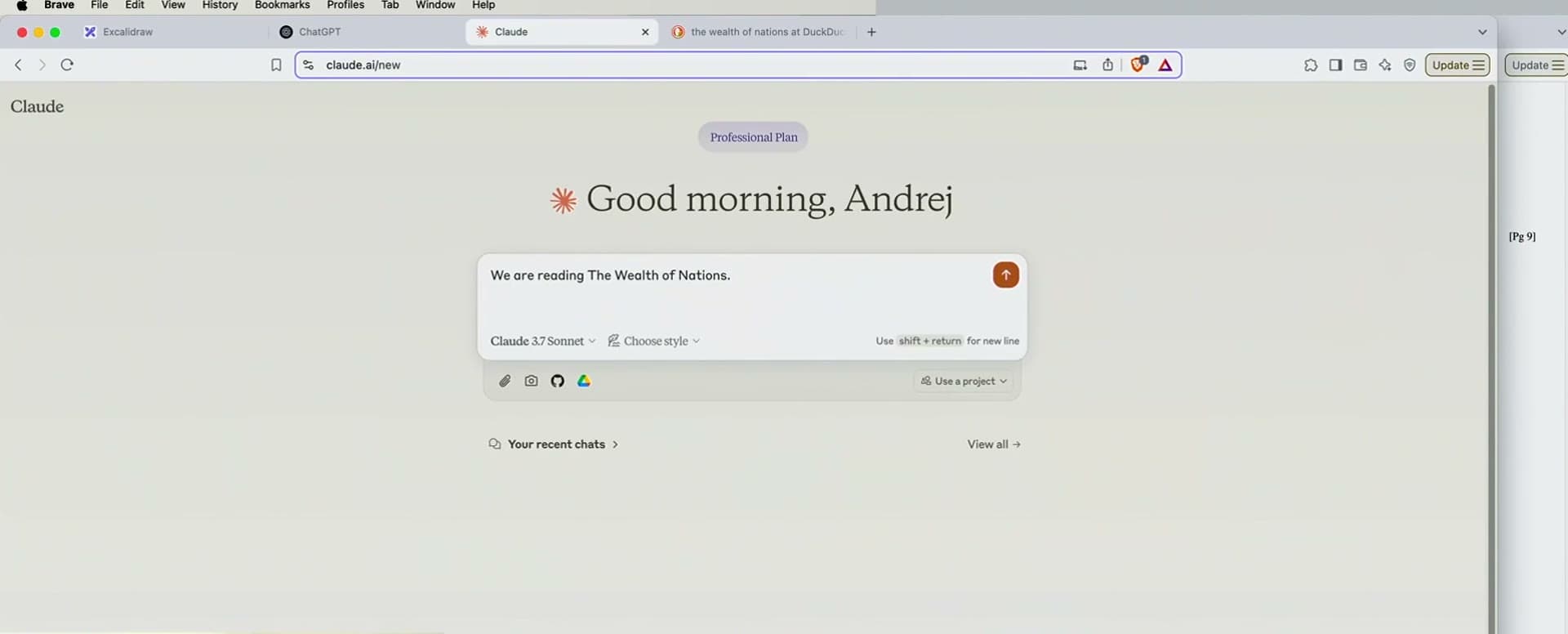
“Going hand in hand with LLMs dramatically increases my retention, my understanding of these chapters… I encourage you to experiment with it and don't read books alone.”
Andrej Karpathy·51:31
The model has a fuzzy memory of famous books but "probably doesn't remember exactly the content of this chapter." Naming it invites hallucination; pasting it puts the real text in working memory so answers are grounded in what's actually there.
He does this with awkward copy-paste and wishes you could just highlight a passage in a reader and ask about it. As of filming, that seamless tool didn't exist — the payoff is worth the friction anyway.
The load-bearing points
- Upload/paste the actual document into the context window — don't rely on recall.
- Reading with an LLM boosts comprehension and retention.
- Best for hard, foreign, or old texts you'd otherwise bounce off.
- Naming a book ⇒ hallucination risk; loading it ⇒ grounded answers.
Read a hard page together
Take one page of something outside your field — a paper, a legal doc, an old book — paste it in, ask for a plain-language summary, then ask two follow-ups about specific sentences.
Show the point
Notice how much further you get than reading it cold. That's the retention effect he's pointing at.
Name vs. load
Ask about a specific chapter of a famous book without pasting it, then paste it and ask again. Compare accuracy.
Show the point
The first answer is parametric guesswork; the second is grounded. This is the whole lesson in one experiment.
It's (most likely) converted to text and loaded into the context window — often dropping images. Once it's in working memory, the model can answer questions grounded in the document's actual words.