Custom GPTs
Save a reusable prompt once — especially a few-shot one — and run it forever.
A custom GPT is, underneath, just a saved prompt. If you keep pasting the same instructions, bottle them into a GPT once; then you only supply the changing part (a sentence, an image). The pro move inside it: give examples, not just a description — a few-shot prompt reliably beats a bare instruction. Karpathy's are almost all for language learning.
His "Korean Vocabulary Extractor" takes a sentence and returns dictionary-form vocab as Korean;English pairs, ready to paste into Anki. Under the hood it's pure prompting — background, instructions, and four worked examples.
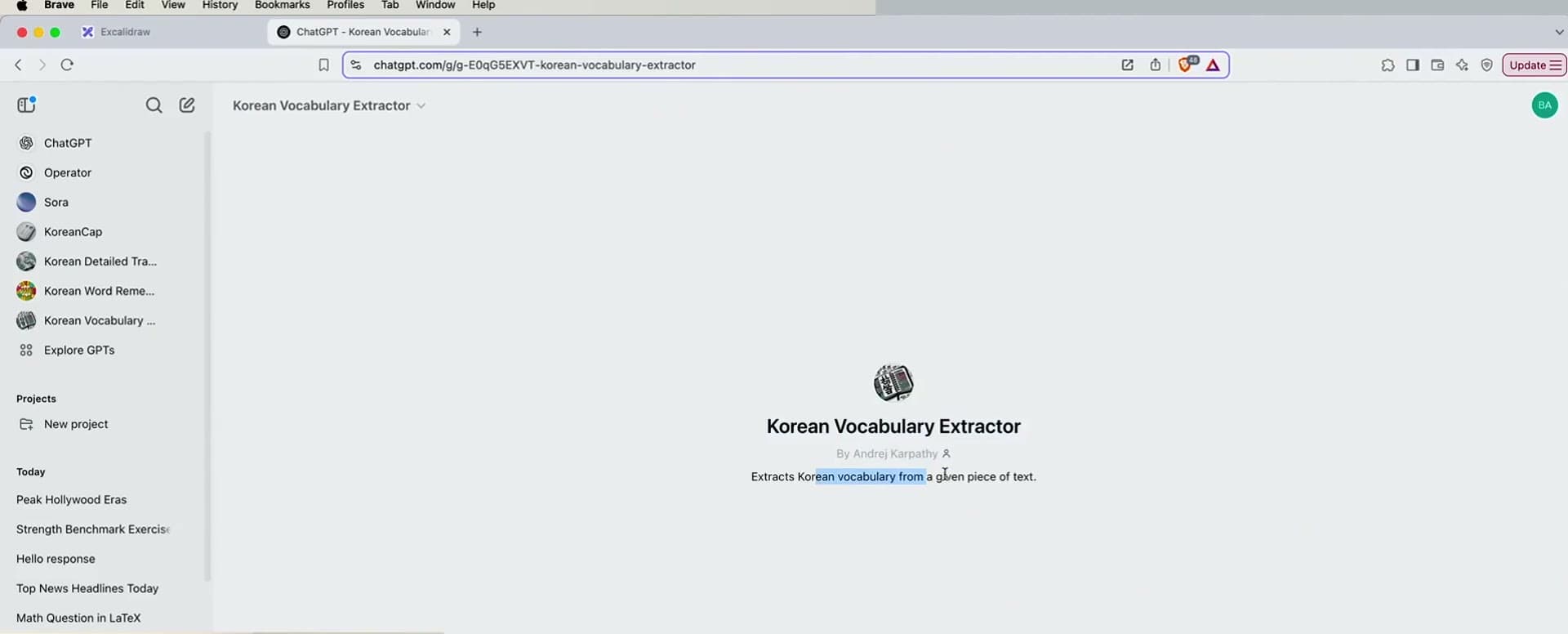
“What I'm doing here really is I'm constructing what's called a few-shot prompt… I'm giving it a few examples, and I find that this always increases the accuracy of LLMs.”
Andrej Karpathy·1:55:21
His "Korean Detailed Translator" goes further — full translation plus a part-by-part breakdown you can ask follow-ups on — and he argues it beats Google Translate outright. A third, "Korean Cap," takes a screenshot of baked-in subtitles, OCRs it, translates, and breaks it down: images + OCR + translation + a saved prompt, tied together.
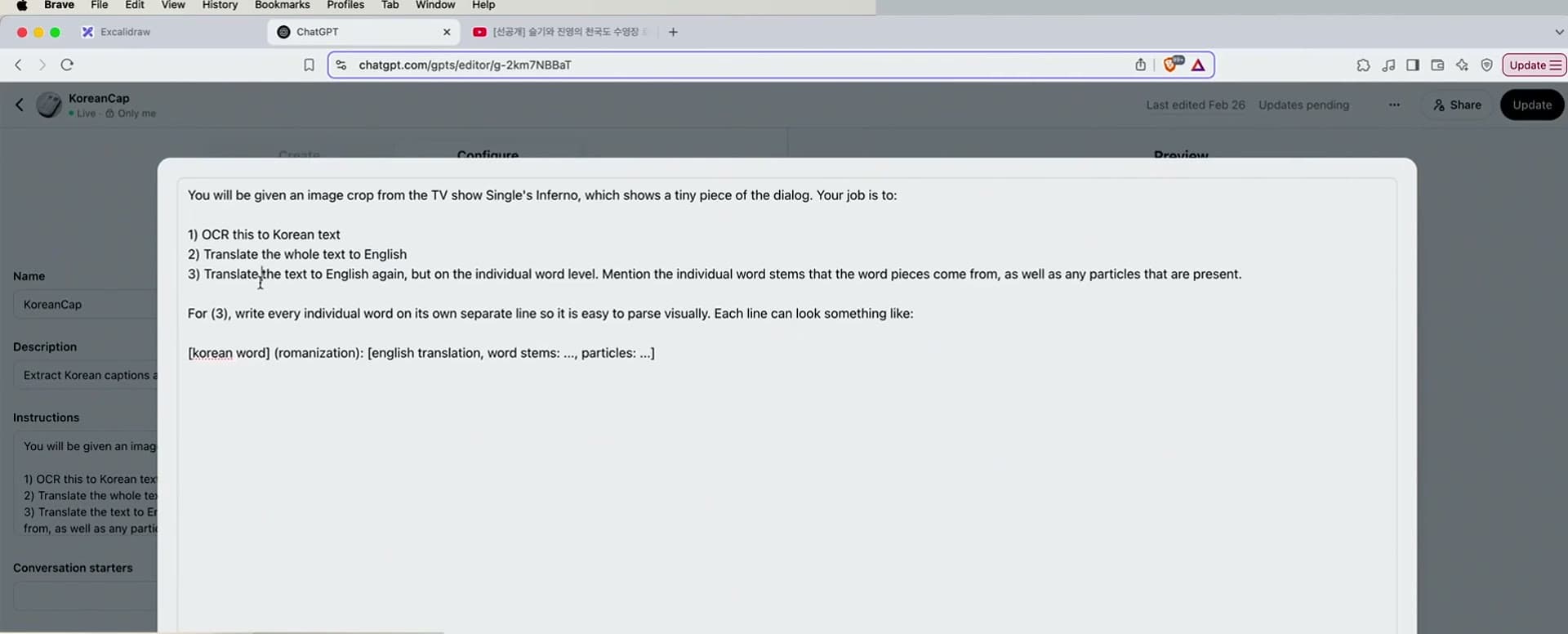
“What this feature really is, is that it's just saving you prompting time. If there's a certain prompt that you keep reusing… just create a custom ChatGPT, save that prompt a single time.”
Andrej Karpathy·1:56:08
Describing a task is “zero-shot.” Adding a few concrete input→output examples is “few-shot,” and it reliably lifts accuracy — the same way you'd show a person how to do a task rather than only explaining it. Wrap examples in clear delimiters (he uses XML-like tags) so the model sees where each begins and ends.
The load-bearing points
- A custom GPT is a reusable saved prompt — set it once.
- Supply only the changing input each time.
- Few-shot (examples) beats bare instructions — use clear delimiters.
- They can chain capabilities (image + OCR + translate) into one tool.
Bottle a repeated prompt
Find a prompt you reuse. Turn it into a custom GPT with clear instructions and 2–4 worked examples.
Show the point
The examples are the point — that's what makes it few-shot and reliable.
Zero-shot vs few-shot
Run the same task with just a description, then with three examples added. Compare accuracy and consistency.
Show the point
This is the single most transferable prompting lesson in the talk.
Showing input→output pairs teaches the task far more precisely than describing it. Like teaching a person by demonstration, few-shot reliably raises accuracy over zero-shot instructions.