“Hi, I'm ChatGPT”
The one-paragraph self-introduction that tells you exactly how to think about it.
If the zip file could honestly introduce itself, it would tell you its own limits. Karpathy's summary is the most useful sentence in the whole talk: knowledge from the internet, read once and remembered vaguely, with a personality programmed by example. Frequent things it recalls well; rare things it recalls badly — just like a person.
“Hi, I'm ChatGPT. I am a one-terabyte zip file. My knowledge comes from the internet, which I read in its entirety about six months ago, and I only remember vaguely. And my winning personality was programmed by example, by human labelers at OpenAI.”
Andrej Karpathy·05:31
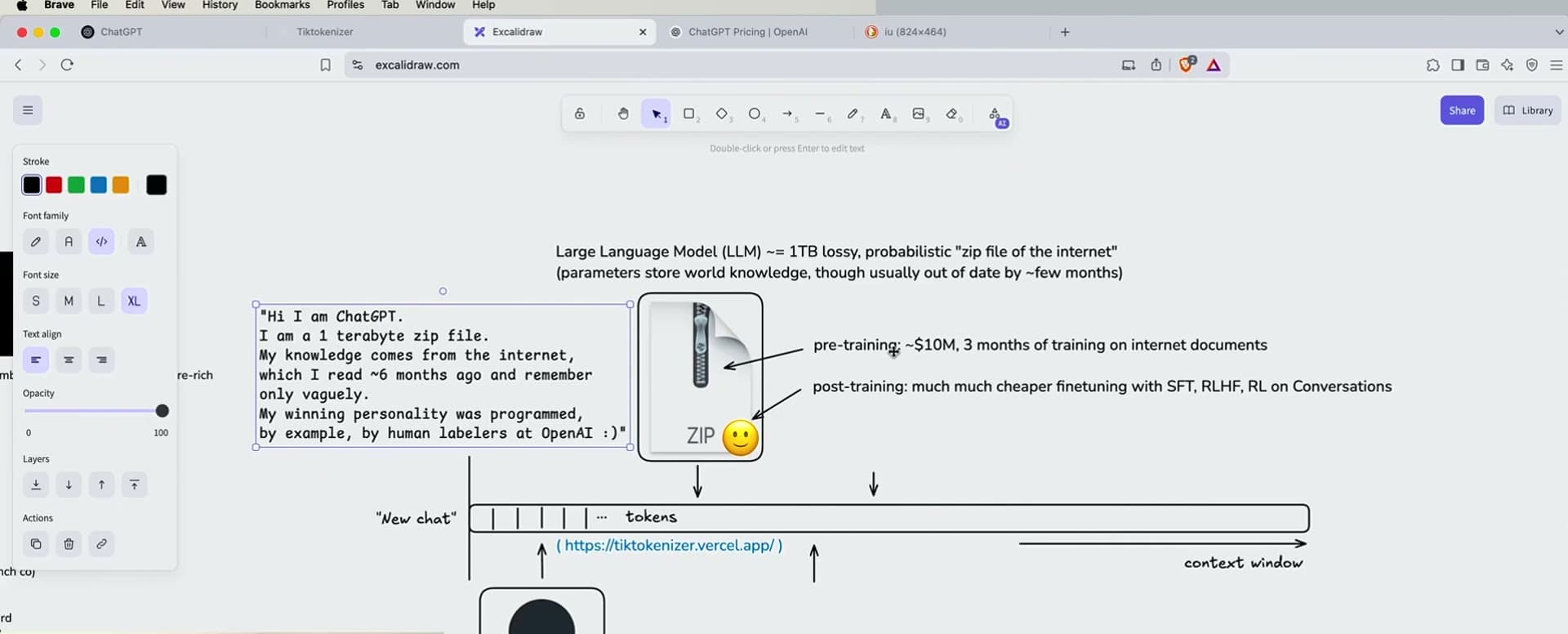
The practical consequence: the model's confidence is not calibrated to truth, it's calibrated to frequency on the internet. Ask about something discussed everywhere and recall is strong. Ask about something niche and it will still answer confidently — but that answer is a probabilistic reconstruction, and it may be wrong.
Before you trust a reply, ask: is this the kind of thing that's all over the internet? If yes, recall is probably fine. If it's recent, niche, or high-stakes, treat the reply as a first draft and verify.
The load-bearing points
- Confidence tracks internet frequency, not truth.
- Common facts → strong recall. Rare facts → confident but shaky.
- Personality is programmed by example in post-training — it's a style, not a self.
Frequency test
Ask the same style of question about (a) a hugely popular topic and (b) something obscure. Compare how specific and how hedged the answers feel.
Show the point
You're probing the “I only remember vaguely” part. Obscurity is where hallucinations breed.
Its output is always a fluent next-token prediction. Fluency is uniform; accuracy is not. Confidence in the prose tells you nothing about whether the underlying fact was well-represented in training.